As we explored the British movements around aviation and climate change, we were struck by the critical role played by data and policy work. Behind every slogan, every flyer, every policy idea was the work of dedicated aviation policy researchers, working to counter industry spin. The nerve center of British aviation/climate research is a group called the Aviation Environment Federation (AEF), a remarkable group simultaneously able to work at the UN level, while continuing to support neighbors disturbed by airport noise. We sat down with AEF Director Tim Johnson about his work.

Playing the global game

Johnson explained to us some of the dynamics around regulating aviation emissions at the international level. While aviation is one of the fastest-growing sources of greenhouse gases, neither the Kyoto Protocol nor subsequent agreements like the Copenhagen Accord address it. Right now, the ball's been thrown into the court of the International Civil Aviation Authority (ICAO), the UN agency managing the sector. The ICAO's working to have policy on aviation and climate change ready for its 37th triennial Assembly, which runs September 28 to October 10. According to the AEF, this "may include targets for emissions reductions, measures to achieve these cuts, and protections for developing countries."

There's a tremendous amount of jostling going on over the fall ICAO resolution. On one side are international environmental NGOs, organized as the International Coalition for Sustainable Aviation (ICSA). On the other side is the aviation industry, trying to get away with a 0% emissions reduction target for 2020. But it's 19 different national governments that call the shots. The European Union wants to build on its Emissions Trading System, while the Americans are closer to the industry position. Mexico, Japan, and Singapore lean toward the American position, and the EU may fall back to it as well. But, as Johnson tells us, "Brazil, China, India, and Saudi Arabia are some of the biggest stumbling blocks. They can't be influenced. What they're worried about is, if there had been an acceptable deal at COP15, that would be fine, but if they agree to a sectoral deal, then they may be pressured to agree to a larger deal." The AEF will be representing the environmental NGOs in the process, and we'll be looking forward to hearing their updates.

America, land of lawsuits and technology

We asked Tim Johnson about the situation in the U.S. As he shared stories, it felt like the American dialogue over aviation emissions is best captured by two lawsuits he described.

The first lawsuit was filed by the good guys. Several US NGOs recently sued the government, charging that the EPA hasn't been regulating aviation for greenhouse gases emissions as required by the Clean Air Act; the EPA welcomed the lawsuit. There may be a bit of a turf war in progress: the industry-friendly FAA has primary regulatory authority over aviation environmental issues, which the EPA may want want more of a voice. Johnson is excited about the prospect of victory; if the lawsuit succeeds, and the EPA's right to regulate aviation emissions is upheld, "it would be the catalyst for an important debate."

The second lawsuit was filed against the European Union by United, Continental, and American airlines, and the Air Transport Association of America. The American airlines are fighting Europe's ability to tackle carbon emissions from foreign aircraft visiting Europe. The AEF joined the case on behalf of the European Union, along with American NGOs EDF, Earthjustice, and the Center for Biological Diversity, as well as European partners WWF-UK and Transport & Environment. While American environmental groups are worried that if the American airlines succeed in escaping European environmental regulations, it may hamper Americans' ability to impose environmental regulations on domestic and foreign airlines in their own airspace.

As Johnson describes it, American NGOs working on the aviation emissions issue tend to be more technology-focused, "not trying to get reductions, just cleaner, leaner aviation"; for example, he points us to the work of US-based groups like the International Council on Clean Transportation. And perhaps this is practical; if climate regulations are stalled in the U.S., better technology may indeed may play a part in the solution, he suggests. What the US does have, however, are local groups responding to airport noise issues; the N.O.I.S.E. network for example, is made up largely of city and government officials concerned about noise impacts, often working behind the scenes, inside the system.

Aviation taxes

An advisory group was set up after COP15, charged with exploring how to raise $100 billion in climate funding. Among the options are an international tax on aviation. Tim Johnson's been following the debate closely, and isn't keen on one leading idea, a small flat surcharge per ticket. He'd much rather see a per-flight tax, or one linked to fuel usage, to better approximate true environmental costs. Linking to fuel would work well, he tells us, because it's a simpler market-based system. Challenges remain. Should residents of small island states, for example, pay the same kinds of surcharges? While different carve-outs are being discusses, it's important to remember, he tells us, that 129 countries are collectively responsible for just 2.5% of aviation emissions.

The other side

We asked Tim Johnson and John Stewart (AirportWatch) about some of the industry lobbies they found themselves campaigning against. They mentioned industry public campaigns Flying Matters and Freedom to Fly, and trade associations IATA (Geneva), the US-based Air Transport Association (ATAG), which brings together a wide variety of players. John described how ATAG were "ferocious" lobbyists, so much so that they even had the time and resources to lobby Caroline Lucas, head of the British Green Party. "If they're lobbying even the Greens, you know they're working hard." As for specific companies, it wasn't only the airlines; companies like GE were quite strong as well.


Our favorite reports

If everything you knew about airports came from reading airport expansion proposals, you could be forgiven for thinking of them as the backbone of the British economy, a magical creator of jobs, stewards of the environment, and purveyor of all that is good and wholesome in the world. The folks at AirportWatch feel differently. As an organization made up of local airport watchdog groups, they come across the same kind of grandiose promises made over and over by airport operators. John Stewart from AirportWatch described to us how critical it was for anti-expansion campaigners to have their own research available, and pointed us to some of the research he found most useful during the Battle of Heathrow. Here are his recommendations, and some of our other favorites found on AEF's website:

  • "The Economics of Heathrow Expansion" (CE Delft, 2008)
    Absolutely decimates the analysis that the aviation industry used to make the case that expansion is good for the economy. Argues for fully internalizing aviation's environment costs.
  • "Airport Jobs: False Hopes, Cruel Hoax" (Brandon Sewill, Aviation Environment Federation, 2009)
    Shows how UK airports don't create jobs, but actually export them. Aviation employment dropped while air passengers rose 30%. The UK has a significant measurable tourism deficit, meaning more Britons take leisure trips abroad than foreigners taking leisure trips to the UK. Large subsidies for aviation are supposed to help the economy, but may accelerate the loss of 860,000 British jobs lost by 2030.
  • "Grounded: A New Approach to Evaluating Runway 3" (New Economics Foundation, 2010)
    A fascinating use of Social Return on Investment (SROI) analysis to evaluate the impacts of construction of a third runway at Heathrow. Uses the UK Department for Transport's own economic models, but updated with current carbon costs, and adding in valuations of community noise, air quality, and blight impacts. The result: instead of creating economic value, the project generates a net social cost of -£5 billion.
  • "Air Pollution from Airports Revealed by Volcanic Ash Cloud" (Environmental Research Group, King's College, 2010)
    Two London researchers measured air pollution levels at Heathrow and Gatwick airports at normal periods, and during the period when the Icelandic volcano shut down flights. Pollution levels near both airports literally dropped to zero.
  • "Excess Baggage: The Case for Reducing Government Flying" (WWF, 2010)
    Shows how the UK government could save over £300 million and about 60,000 tons of carbon over the next 3 years by banning 'unnecessary' business flights, 90% of which are domestic

Pretend the world's scientists have informed us that climate change is the greatest threat to human civilization, and that the clock is ticking. Pretend your government has laws on the books commiting it to an 80% carbon reduction by 2050, but the fastest-growing source of dangerous pollution refuses to slow down. What would you do?

"Climate change is the greatest threat to civilization, and aviation is the greatest threat in the UK, and direct action is a reasonable tactic." -Josh Moos

As we started learning about the links between aviation and the climate emergency, one name kept coming up over and over in the British media: Plane Stupid, a gang of merry direct action pranksters using direct action (civil disobedience) tactics to help curb the growth of airports and aviation, Britain's fastest-growing source of greenhouse gas emissions. They've often managed to single-handedly keep the issue alive in the public eye, putting themselves at risk shutting down taxiways, hanging cheeky banners off Parliament, and performing billboard modifications since 2005.

JOINING UP: We interviewed Plane Stupid activists Josh Moos, Dan Glass, and Lily Kember, as well as long-time collaborator John Stewart. All three struck as deeply thoughtful and responsible. Josh was learning about climate change while a university student, when he learned about Plane Stupid. He did his first action at the East Midlands airport, for which he was fined by the courts. Dan, the president of his university student body, organized a benefit for him, and subsequently got involved himself. Lily described to us how she felt a moral imperative to take action after seeing the impacts first-hand at Climate Camp 2007 in Heathrow.

OPERATION TRUTH-TELLING: The conservative Sunday Times published leaked documents showing how the Department for Transport colluded with Heathrow's operator BAA to prepare for a supposedly-neutral public consultation on expanding Heathrow, even creating a joint "rogues list" of people and institutions opposed to expansion. At the end of the consultation period, with 89% of public comments opposing expansion, five Plane Stupid members climbed onto the roof of the Parliament building to unveil a giant banner saying "BAA Headquarters" to graphically highlight the not-so-secret links between the government and aviation industry officials, in a way no amount of impassioned letters to the editor could.

"Plane Stupid was equally sceptical of the motives of a lot of the media but attempted to use it, even out-smart it, to get its point across and influence opinion." -John Stewart

MEDIA: Some direct action activists are suspicious of the mainstream media. Plane Stupid embraces the media, carefully designing actions for maximum mainstream media impact. Love them or hate them, the press can't seem to get enough of them. "The activist community sees Plane Stupid as media babies, the ones who do interviews, rather than spitting in their faces," explains Josh. "The media is just playing a game, just like you're playing a game." The stakes can be high. "Papers call you a terrorist, and you end up fighting the untrue narrative, instead of telling your own." Lily described being personally attacked in the press when she was the spokesperson for the Stansted Airport action. But Plane Stupid continues to attract attention, and have been featured in unlikely outlets like Time Out and Vogue UK, even as they're subjected to police infiltration.

OPERATION SUPERGLUE: At the end of his life, Dan Glass may still be best known as the guy who superglued himself to the Prime Minister at an awards ceremony. He described the backstory, how at the height of the campaign to prevent the expansion of Heathrow, he was invited to receive an award for his work in aviation-impacted communities from the very man responsible for the problem. Dan dabbed glue on his hands during Gordon Brown's speech, and stuck himself to the Prime Minister's sleeve, telling him "Do not worry, this is a non-violent protest...We cannot shake away climate change like you can just shake away my arm. We can beat climate change, but this is not going to happen by planning the world's largest international airport at Heathrow." He got a round of applause. The incident got tremendous attention as a wacky news item in the papers, draw attention to an issue thousands of campaigners were working on.

"Stop short flights, stop expansion, help workers move to greener industries." -Dan Glass

TARGETS: In 2010, campaigners scored a huge win when plans to expand Heathrow were finally shut down for good by the new government. "It's strange," Dan laughs, "to have [Conservative Prime Minister] David Cameron agree with us." But for Plane Stupid, winning the Battle of Heathrow was the first step of a much larger campaign to bring aviation down to earth. For Josh, the focus is on regional airports, which have their own unsustainable expansion plans, from Manchester Airport (which wants to expand to the size of Heathrow) to London City Airport (which wants to double, maybe even teaming up with Red Bull). Josh lists three goals for the future: an end to domestic short-haul flights, a ban on aviation advertising, and a just transition for those working in the aviation industry. He's particularly concerned about the labor angle. "The workers in the aviation industry are not the enemy...we need a just transition so we don't see thousands of people unemployed by our success." He cites Plane Stupid's support for BA workers' campaigns, as well as emerging labor-led campaigns for a million climate jobs.

OPERATION STANSTED: In 2008, while the Climate Act was being passed, the operators of London's Stansted airport unveiled huge expansion plans: a second terminal, four hotels, and twice as many parking spots as Heathrow. Local residents group Stop Stansted Expansion described the plans as "going beyond environmental vandalism and being tantamount to a declaration of war on the local community and global environment." That December, Plane Stupid led a group of over 100 in the dead of night to occupy the taxiway at Stansted, the biggest airport occupation in UK history. This was the first time that they'd ever meaningfully inconvenienced passengers. It wasn't an easy decision, but the stakes had never been higher. Young people, with support from sympathetic scientists, were willing to stand up to stop climate change, and the aviation industry was on notice. (After years of campaigning, the Stansted expansion plans were permanently dropped in 2010.)

"How do you make a pariah of the aviation industry?" -Dan Glass

SUBVERTISING: Why end advertising for aviation? Says Josh, "The aviation industry always says 'we supply because there's a demand.' If there's inherent demand, why do they need to advertise? It's everywhere, on the tube, on the buses." Ads for tobacco products are banned in the UK; Plane Stupid contends that aviation is equally unhealthy to society, but until it's illegal, they're working to make air travel ads uncool, in traditional culture jammer style. They just ran a 48-hour contest for the best enhancement of aviation ads. There were a variety of entries, but my favorites include the enhanced government travel warning and the audacious addition of a line of truth-in-advertising to a large Cathay Pacific billboard in London: "Great service. Great people. Great fares. More emissions." The group offers sticker templates for the interested.

"The community has been impacted so long. They need to be able to resist future threats." -Lily Kember

GOING LOCAL: We appreciated the fact that Plane Stupid members do more than swoop in for high-profile actions. We talked to Lily Kember, the media spokesperson for the Stansted action. As the most visible figure, she was subjected to harsh personal attacks in the media. Though happy with the results, she was relieved to be out of the spotlight, so she could focus her energy on Plane Stupid's "Adopt A Resident", program, in which direct action activists paired up with individual residents fighting to save their homes from the expansion of Heathrow. Activists pledged to help residents defend their homes; some even moved into the area, ran film screenings, organized a barn dance. "It was one of the best things we did, seeing the impact it had on people in the community," Lily remembers. Writes John Stewart, "The activists were welcomed into a community which had become worn down by nearly ten years of struggle... they were not on their own". Lily told us about Transition Heathrow's Grow Heathrow project, a squatted community garden worked on by half newcomer activists, half residents. Since March, they've cleaned up and transformed half an acre of an abandoned derelict World War II era market garden, now growing everything from blueberries to bok choy, with seeds and plants donated by the community. The goal? To provide fresh food and become a community hub. They've run permaculture courses, participated in community festivals, and just ran their biggest event yet, a three-course banquet for over 65 garden volunteers and friends, made with food grown on the property, topped off with elderflower champagne. The activists moved to Sipson for political reasons, but some have stayed on in a community where for many long-time residents, moving away when Heathrow attacked never an option. Says Lily, smiling, "suddenly I'm waving to people as I bike around." It's a good feeling. (Grow Heathrow is under threat; find out how to help.)

Plane Stupid works within a larger context, where they're providing edge and visibility to the struggles of thousands of people. It's refreshing to see direct action groups so visibly building accountability to those for whom they struggle. There's still very little awareness of the climate impacts of aviation in the U.S; perhaps we need some Plane Stupidity of our own.

Learn more:

The Battle of Heathrow was a decade-long campaign to prevent the massive expansion of Heathrow airport. Initially started by local homeowners worried about local impacts, it eventually grew into a struggle over the future of British climate policy. Near the heart of the struggle was John Stewart, the chair of AirportWatch, who helped hold together a diverse coalition working on the issue. In 2008, the Independent called him Britain's most effective environmentalist. We got the chance to interview Stewart for several hours at the beginning of our time in London. He was still delighted about the Heathrow victory, and excited to share the story with us, along with a draft of his exciting new history of the campaign.

THE SITUATION: Heathrow Airport is the busiest airport in Europe. In 2002, the Labour government expressed interest in further expanding Heathrow by building a third runway and sixth terminal, part of a national airport expansion strategy developed with aviation industry lobbyists. Stewart told us that Department for Transport civil servants were very strongly biased in favor of airline industry lobbyists (and against alternatives like rail, as well as the needs of impacted communities). Former aviation minister Chris Mullin wrote that "the demands of the aviation industry are insatiable" and "the relationship between the airlines and the Department is too cosy." As the idea continued percolating in government circles, the Department ran a public consultation period from November 2007 to February 2008, with a decision to be made afterwards.

THE THREAT: Various constituencies were opposed to the third runway, including communities whose homes would be destroyed in the expansion, and London residents fed up of ever-increasing airport noise. But the planned expansion was particularly critical for climate activists:

  • Aviation contributed about 11% of the UK's total greenhouse gases in 2008
  • Aviation is the fastest-growing source of UK greenhouse gas emissions: aviation emissions had doubled since 1990, while emissions from all other activities had fallen 9%
  • The UK's 2008 Climate Change Bill required 80% emissions cuts by 2050, but there was no way to hit that target if you kept increasing aviation (per one analysis, at current growth rates, aviation would use up half of Britain's planned national 2050 carbon budget)
  • The expansion would most benefit the 10% of "binge flyers" who take 5 or more international flights a year, while most harming international climate-impacted communities

THE TEAM: John Stewart and Sarah Clayton helped build and manage a broad new national coalition called AirportWatch, made up of groups with a total membership of 6 million people, working on issues ranging from noise to global justice to bird protection. He described how to counter the aviation industry, "we had to build the biggest coalition against airport expansion ever seen." Stewart credits AirportWatch's loose nature and big tent as major assets. In 2007, Heathrow operator BAA handed tried to get an injunction banning AirportWatch members from coming to the Heathrow area; they had no idea they were targeting 6 million people, and the resulting court proceedings were a free PR coup for AirportWatch. Members agreed on their opposition to a third runway, but sometimes not much else. "The critical thing was for members to meet each other as individuals, to eat together, know each other as people, not organizations." He points to the example of Hounslow Councillor Barbara Reid, a "pretty traditional Conservative" from an impacted community who was able to work well both with her party, as well as with young climate activists. Members were willing to work together with unity of purpose, with a diversity of tactics. (Not that it was always easy; for example, many elected officials were particularly squeamish about coordinating with groups engaged in civil disobedience, but the coalition held together.)

STEP 1: FOCUS ON THE LOCAL: The expansion of Heathrow would destroy the village of Sipson, a community of 3,000 people located south of Heathrow. The threat of community destruction and forced relocation galvanized many residents. Residents of Sipson and nearby communities formed the No Third Runway Action Group (NoTRAG) to fight for their homes. Community members had their futures held hostage by the sudden threat of Heathrow expansion. As the most immediate victims of any Heathrow expansion, NoTRAG members were on the frontlines of the campaign, building up organizing capacity with support from coalition partners. Simultaneously, London residents whose homes were exposed to tremendous (and ever-increasing) airplane noise were organized as HACAN ClearSkies. John Stewart came out of that camp; as Heathrow air traffic grew, he had planes flying over his South London home as frequently as every 90 seconds. Member-supported HACAN paid Stewart's salary, and helped drive the Heathrow coalition. Local activists were tremendously effective in winning the support of local political leaders; NoTRAG was supported directly by the London Borough of Hillingdon, while local authorities provided the use of town halls for meetings.

STEP 2: CREATIVE GREEN ACTION: Environmental direct action played an important role in the Heathrow struggle, most prominently via Plane Stupid, a network of media-savvy anti-aviation direct action pranksters. Plane Stupid regularly made headlines, through "serious" actions like occupying runways, as well as media-bait like an activist supergluing himself to the Prime Minister's jacket at an awards ceremony, telling him "we cannot shake away climate change like you can just shake away my arm." The anti-expansion direct action movement grew at Climate Camp; Climate Camp 2007 was held right outside Heathrow in threatened Sipson, frightening BAA. Greenpeace was very involved behind the scenes; their high-profile "Airplot" program gave away fractional ownership of land on the runway site to 90,000 people, a media-friendly protest and potential legal maneuver to slow down forcible land acquisition. Work with impacted communities was a hallmark of the direct action movements. Several Plane Stupid members moved to Sipson, while activists from around the country later participated in an "Adopt A Resident" program. Seeds of Change and Plane Stupid later did action trainings with community members, who went on to do several actions of their own, including at a major London aviation conference. 600 people later participated in a safe legal flash mob, wearing red "Stop Airport Expansion" t-shirts inside Heathrow airport.

STEP 3: CHALLENGE THE ECONOMICS: It was pretty clear which step John Stewart was most excited about; "for the first time, we challenged their economic arguments." The case for expanding Heathrow was based on discounting social costs and inflating job creation estimates. HACAN took a risk by commissioning respected Dutch economic consultants CE Delft to write an independent report on "The Economics of Heathrow Expansion." The gamble paid off: the resulting report was critical of the report that the Department for Transport was using, and concluded that businesses would not leave if a third runway weren't built. HACAN launched it in London's financial center, and it was written about positively in leading financial papers. Other reports disproved job creation claims, and used social ROI analysis to show how instead of helping the economy, a third runway would cost Britain a net £5-£7.5 billion. Credibly challenging the economics of expanding Heathrow helped divide business and union support for the project, and drew attention from sectors that wouldn't normally be swayed by demands from treehuggers or NIMBYs.

STEP 4: GET POLITICAL: While the Labour government was pushing the third runway from the top down, local campaigners were doing extensive lobbying to win the support of elected officials, building a cross-party group of MPs and local officials opposed to the expansion of Heathrow. The campaign won the support of numerous local government agencies, several members of the London General Assembly, and in 2008, all four major candidates for London mayor. Labour was divided, while the Greens and Liberal Democrats were both very supportive of the campaign. Several AirportWatch coalition members were active Conservatives, and helped push the campaign within the party, as it worked to develop policy platforms. But it still came as a big surprise when the Conservatives announced if elected, it would end plans to expand Heathrow, while investing in high speed rail instead. Conservative leader David Cameron even sponsored a tree on the Greenpeace Airplot.

VICTORY! As 2010 rolled around, campaigners won a major court decision challenging the basis for the Labour government's Heathrow plans. The elections were coming up in May, and it was clear that opposition to the third runway was stronger than ever; NoTRAG polled local candidates for the House of Commons, and found 82 of 85 responding candidates opposed the Heathrow expansion. Labour lost the election. The day after the new Conservative-Lib Dem government was formed, it formally put an end to the expansion of Heathrow and the other London airports, ending a decade of struggle.

Massive high-profile wins are so rare. Sadly, we left London too soon to attend the massive victory party planned for August 28. John Stewart invited us to an AirportWatch meeting, where we saw how much work is still left -- ending national airport growth, curbing noise issues, building better alternatives. Campaigners are still dreaming big. But this victory is still sweet, and we know organizers are savoring the moment.


Timeline:

  • 1997: British airport watch groups begin coordinating
  • 1999: Govt. publishes flawed The Contribution of Aviation to the UK Economy report
  • 2000: AirportWatch coalition formed
  • 2002: Govt. discusses third runway plans; local counter-campaigns begin
  • 2003: Govt. Air Transport White Paper plans tripling of air passengers by 2030
  • 2005: NoTRAG gets active defending community; local politicians pay attention
  • 2006: Green direct action activists organize at Climate Camp; Plane Stupid takes off
  • 2007: Heathrow Climate Camp; public consultation period on expansion begins
  • 2008: Meetings, reports, direct action during consultation period; Climate Change Act sets CO2 targets; support from Conservatives
  • 2009: Govt. decides to allow expansion plans; responses: legal challenge, Airplot, direct action, cross-party organizing
  • 2010: Court finds govt. decision flawed; final victory with Conservative-Lib Dem election win

Want to learn more?

Read John Stewart's excellent Heathrow campaign history "Victory Against All the Odds", and check out the websites of some of the major campaign participants:

I'm writing this on day three of a two-week journey from Europe back to the United States. We had lunch with the captain (mushroom soup, salad, Sri Lankan curry), enjoyed the sun on the upper deck, and returned to our room, me on my laptop, Barnali curled up with a copy of The Girl Who Kicked the Hornet's Nest, quietly humming a song. Who knew that time aboard a container ship could feel like such a luxurious experience? This is what slow travel feels like. And it's one of a wide range of responses to the fact that aviation as we know it is dangerously unsustainable.

Our flight-free trip was inspired in large part by work being done in the UK. The British environmental and policy community have managed to inject the issue of the massive climate impacts of aviation* into the general public discussion, to the point where it's a matter of mainstream political and ethical debate. We wanted to know more.

But then something amazing happened right before we arrived in London.

Against all odds, the British climate/aviation community won the Battle of Heathrow.

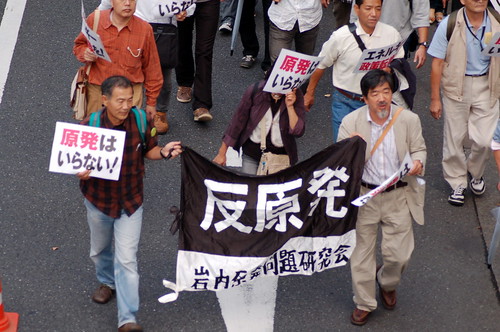
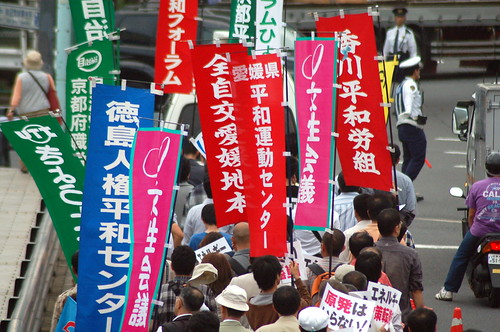
For the past decade, a grassroots coalition has been fighting a planned major expansion of Heathrow Airport, which, if completed, would have busted Britain's national carbon budget. It was a classic David vs. Goliath fight. On one side were resident groups, environmental NGOs, green direct action groups, and everyday concerned citizens. On the other, the Labor government, airport authorities, business groups, and airlines.

How did the Davids alter the course of public and business debate? How did neighbors and environmentalists convince a Conservative Prime Minister to take on the aviation Goliaths, and permanently halt plans to build a 3rd runway at Heathrow? We did about a dozen interviews to uncover this story, and that of the various movements taking on the massive climate impacts of aviation.

We'll be posting the stories in about six parts over the coming weeks. We left London feeling incredibly inspired; we hope you'll be as well.

At home, we feel like the only ones we know talking about this issue. There was such a tremendous sense of relief being in a place where these questions are part of mainstream policy discussions. We're not crazy, we'd tell ourselves. A majority of Britons support curbing aviation growth. They've figured out something very important here, and more people need to know.

* The facts are clear. Flying is responsible for about 5% of human impact on the climate -- and at current rates, emissions will quadruple by 2050. But flying remains an elite activity; roughly 95% of the people on the planet have never flown. There's no debate on the scale of the impacts; the aviation industry acknowledges them as well, and even recommends trains on their own website.

We've safely crossed the Atlantic by container ship (barring a 24-hour engine repair at sea). We had hoped to find passage from London to New York, but the closest we could find was a booking on a ship from Liverpool, England to Chester, Pennsylvania. We ended up spending two weeks aboard the MV Bonavia, a German cargo ship flying a Liberian flag, on a trip that was surprisingly different from the journey across the Pacific that kicked off our trip.

Leaving Antwerp: Freighter travel requires flexibility. Our ship was was delayed by a week due to repairs, and we were warned that it might even skip the Liverpool stop to stay on schedule. It would apparently be safest to board at the previous stop in Antwerp, which is we started our long journey west from England by heading to Belgium. We took the Eurostar from London across the English Channel, spent a night in Brussels, and took a 30 minute train ride to Antwerp. We took a taxi from the station to the marine police office to complete immigration proceedings and boarded the ship that evening. The next evening the captain knocked on our door, inviting us to watch the ship maneuver out of port, passing through a tiny gate, and then a series of locks. The lights around the port started to come on, and the machinery looked like a mini cityscape. It was magical to behold.

Life on board:: The MV Bonavia was smaller and older than the MV Hanjin Madrid, the container ship that had carried us from the US to Japan at the start of our trip. There was no elevator, and the exterior decks were small. Our large wood-paneled room was right below the bridge, making it easy for us to run up to the bridge and upper deck every day, investigating the map, staring out at the water. We were starting a 14-day journey back home and we had come prepared. Anirvan spent time writing about the inspiring anti-aviation activists we had met in London. I sorted through photos and gorged on books good and bad, reading almost a book a day. We listened to missed episodes of favorite radio shows from back home: This American Life, The Moth, and Wait, Wait, Don't Tell Me. We enjoyed the days when we got an extra hour as we crossed time zones. Spending time was not an problem.

Crew: What the new ship lacked in style and size it made up in soul. The crew of about twenty was a mix of Croatian, Polish, Lithuanian, Filipino, and Sri Lankan. They were incredibly cheerful; the Filipino steward and Sri Lankan cook always had particularly big smiles on their faces. Meal times were mostly silent on our previous ship, but here, we managed to have conversations with the Lithuanian captain and a friendly Filipino officer on topics ranging from the future of digital media to Filipino entrepreneurship. Though there were rumors that another passenger might join us in Liverpool, she never turned up, and we ended up being the only two passengers on the ship.

Food: An unexpected benefit of having several Sri Lankan crew members was a Sri Lankan food option at every meal! I had not expected to see any spices on this trip, let alone papadum (lentil cracker, popular in South Asia). One day we even had a dried fish curry. After a few days, we had figured out a way to ask for only vegetarian food without appearing to be fussy or strange, a task made easier by the fact that the Sri Lankan food was mostly veg; we'd been warned several times that cargo ships don't accommodate special diets. But one day I just had to try the ox-tail, apparently a common dish on ships; the verdict: strange-looking, but flavorful. We decided to skip breakfast everyday. Not only were the breakfast timings too early for us, but we couldn't possibly manage to eat three full sailor-sized meals when our primary physical activity was climbing the six floors down to the mess. It helped that we had brought some fruit, crackers, juice, and Belgian chocolate with us, to fill in the rare hungry gaps between mealtimes.

Weathering the storm: We weren't sure our ship would actually make it. There was the one week delay for repairs, and an unexpected extra day spent at Antwerp, before we docked at Liverpool. We left Liverpool on schedule, but when we woke up the next morning, we found that the ship had stopped. Apparently a cylinder liner needed replacement, and it was a 24-hour job. That night there were strong winds and they hit the ship hard as she drifted on the ocean. With the engines turned off, it should have been a quiet night, but it felt like a small earthquake was hitting the ship every ten minutes. Finally at 4:00 AM, the ship roared back to life, moving at high speeds to make up for lost time, making me sick. But that lasted only a day, and was nothing that sleep and toast couldn't cure. In the days that followed, the ship made its way steadily across the Atlantic, arriving in Chester, Pennsylvania only four hours behind schedule.

Dolphins! We watched the ocean mostly from our windows and the bridge deck. On the twelfth day, we decided to head to the prow and hang out in the sun. We were there for almost an hour, talking about our year, and our life back in Berkeley. The ocean was glimmering in the sun and we both felt in awe of the experience of being on the ship. Birds glided on the ocean. And I thought aloud, "if only I could see dolphins, my trip would be perfect." Dolphin sightings are apparently quite common, but only if you are spending a lot of time on deck or on the bridge. And then suddenly there were two dolphins jumping next to the ship; they were beautiful, and I didn't quite know whether to stare at them or photograph them. It was everything that I'd hoped to see. Ten minutes later, two more dolphins appeared. They disappeared under the ship and we ran across to find them on the other side, by which point in time we realized that we'd run into an entire school of dolphins, leaping up from everywhere and playing at the front of the ship for several minutes. It was breathtakingly beautiful, a moment we will cherish forever.


Related slideshow: Life aboard a transatlantic freighter: from Antwerp to Chester

Related post: Across the Pacific by container ship, from Seattle to Japan

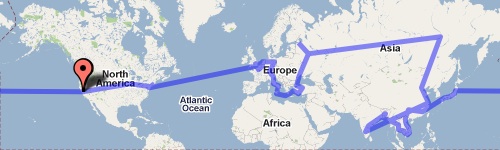
Our year of no flying is coming to an end. We left home on September 15, 2009, traveling from the US through Asia and Europe by container ship, ferry, train, and bus. We just spent three weeks in London with our friends Indraneel and Debipriya, where we got the chance to dig deeper into the aviation-critical movements that inspired our trip.

By the time you read this, we should have set sail from Antwerp to the East Coast of the United States aboard the container ship MV Bonavia. We loved our experience crossing the Pacific on the MV Hanjin Madrid; we're hopeful that this journey will work out as well as the last one.

We're offline for two weeks as we cross the Atlantic, but you can try tracking our ship's position and arrivals. If everything works out, we'll arrive at Philadephia's port of Chester, around August 24. Wish us luck as we cross the big pond.

BP Summer Big Screens

As we were planning our time in London, our friend Indraneel emailed us about the Royal Opera's free open-air events, a.k.a. "BP Summer Big Screens." It was a bit of a shock seeing pictures of people at an event named after America's a environmental villain #1; it would be like attending the "Boston Strangler Summer Days at the Opera." Didn't anyone at the Royal Opera read the news, or realize that their event was now linked to the mass destruction of American ecosystems and jobs?

National Portrait Gallery BP Portrait Award 2010 website screenshot

We've been in London for two weeks now, and BP's everywhere. Signs all around the British Museum are festooned with BP logos. The Tate just threw a party to celebrate their twentieth anniversary of BP sponsorship. But the National Portrait Gallery was the worst; I couldn't bring myself to go into the hall celebrating the BP Portrait Awards.

Apparently someone's noticed. We've been in London for two weeks now, and have been delighted to see Londoners use creative tactics to highlight the role of cultural institutions being used as BP greenwash:

But these actions are the tip of much larger pushback, with artists and critics publicly reconsidering the role of oil sponsorship. The Tate is the highest-profile target, with groups of artists like Liberate Tate pressuring the Tate to drop BP sponsorship by 2012, citing the museum's own public commitment to offer "leadership in response to climate change" as well as its ethical donor policy.

Is this just symbolic politics? I talked to Kevin Smith from London-based arts/environment group Platform, who described how processes like sponsorship are a vital part of the social license that holds up the real-world "carbon web," giving oil companies the capacity to operate with public sanction, disguising the industry's impacts on local and global environment, militarization, and conflict.

According to Platform:

"Apart from catastrophic spills...there are a whole host of adverse impacts that are associated with the production of oil...In order for an oil company to product oil and transport it to the global market, it needs either the support or the silence of the population in those areas of the world in which this takes place....The building of social license takes place to a...[great] degree in the cities...such as London...Here, Shell and BP have between then sponsored almost all of London's most prestigious museums and cultural institutions over the course of the last decade.

The financial support that the companies provide strengthens their perception as a part of Britain's cultural and social elite, and creates a perception of making a positive contribution to our society. This in turn not only provides them with an important profile with ordinary fuel consumers, but far more importantly strengthens connections between the corporations and vital bodies such as government departments. The support of institutions such as the Foreign & Commonwealth Office, or the Department of International Development, are far more important to the global operations of Shell and BP than that of the populations near the oilfields or on the pipeline routes. These relationships are made at the gala openings and concerts, where the audiences made up of civil servants and decision makers rub shoulders with the oil executives.

A decade ago, tobacco companies were seen as respectable partners for public institutions to gain support from -- the current BP Portrait Award at the National Portrait Gallery as previously sponsored by Imperial Tobacco. Now it is socially unacceptable for tobacco to play this public role, and it is our hope that oil and gas will soon be seen in the same light, as the public comes to recognize that the sponsorship programmes or BP and Shell are means by which attention is distracted from their impacts on human rights, the environment and global climate.

On the local level, it often involves extreme forms of pollution for local communities, while regionally oil is frequently associated with greater militarization and conflict. Globally, carbon emissions, oil companies, and our collective dependence on the product they push, are taking us ever closer to the edge of climate catastrophe."

Our year has been an exploration of what life looks like in a world without aviation, where planes have been grounded for environmental bad behavior. Traveling plane-free doesn't require incredible skills or strength, only patience, a little extra cash, a lot of extra time, and an appreciation for landscapes that are continuous and change slowly. You can imagine how excited we were to hear that our friends Eric and Rachel lived next to a historic dead Berlin airport newly converted into a park. Could airports someday face the same future as old train stations, dripping with nostalgia, but surpassed by other modes of transport? We couldn't wait to visit.

ENCOUNTER: Tempelhof Airport, site of the Berlin airlift, has been transformed into a park and exhibition space. We started off walking through the park to visit a design exhibition inside the old hangar. The hangar and the main building were not directly accessible from the park grounds, and though it would have made sense to walk along the fence, the view from the street of the huge open field was irresistible. We made our way in through an entrance in the fence that still surrounded the park, and suddenly we found ourselves walking on a runway. Children roller skated around us, others biked along, some strolled. On the grassy meadows between the two runways, families, mostly Turkish, picnicked on the grass and took breaks to throw a ball around. A local little league team played on a baseball field which we later found out was a leftover from the days of the airlift when the American troops were stationed here. We walked past a beer garden where soccer fans were watching the World Cup, with the omnipresent sound of the vuvuzelas coming from the TV.

With the runway pavement symbols under our feet, and the air traffic control tower in the distance, we could never forget that we were in an very different kind of park. We walked around in a state of constant fascination and found our way to the building entrance. Bikes were now parked in the drop-off areas, a Nazi eagle sans swastika still sat mounted on an outside wall. In the central hall, the check-in counters still had the names of airlines on them, standing like silent spectators. The baggage carousel was a stationary bench. A departure gate led to the exhibition space under the mighty cantilevered roof, and we walked into the hangar for the exhibition we'd come to see.

HISTORY: Tempelhof was no ordinary airport. The massive building was built by the Nazis in 1923, designed to be monumental and majestic, a symbol of the power of the German state. After World War II, Tempelhof fell on the West German side of Berlin. When Soviet troops blocked road access into West Berlin in 1948, the Allies flew millions of tons of supplies into Tempelhof Airport, the largest military airlift in history. While best known as a site of the Airlift, the fields also witnessed the maiden flight of the Zeppelin, and was also the place where Orville Wright set a world record by staying afloat for a whole minute. But long before that, it was just a field, a forest that had been cleared out for agricultural purposes. We tried to imagine its future in our world threatened by climate change, where the growing aviation industry is one of the worst offenders, but still flying largely under the public radar. Though airports may one day become a vestige of the past, finding new ways to use them would provide a new set of challenges.

PLANNING: We met Almut Jirku from Berlin's Senate Department for Urban Development to learn how the rebirth of Tempelhof was planned, and the design competition under way to decide its future. "This competition was more challenging than most because it is a high profile site...We want this to be a model site." After unification, planners decided to decommission Tempelhof, finding that having three Berlin-area airports was economically unsustainable. Some nostalgic West Berliners wanted to keep Tempelhof functional, but the efforts, culminating in a public referendum, failed. Tempelhof was shut down in 2008, to be turned over to Berlin residents as a park. Jirku told us that the project's public participation process was particularly challenging; nearby residents, many of whom are immigrants, returned very few surveys. A second attempt with more collaboration with community leaders was more successful.

Jirku manages the design competition to decide the future of the site. The extensive design brief for the park lays out the requirements: architects have been asked to submit plans that include community gardens, cemeteries, recreational amenities, bathing facilities, and nature and adventure trails. Separate plans exist for possible housing and office space in the old airport building area. The possible uses of the site are as massive as its size: nearly four square kilometers or two square miles in size. The budget for the redesign is 61.5 million Euro, a substantial investment for a city during a recession.

COMMUNITY: We were intrigued by the stickers and posters in the neighborhood that asked people to "Reclaim Tempelhof" or pushed people to direct action with the bold question, "Have you ever squatted an airport?" The name of the two groups that came up with Tempelhof Fur Alle and Squat Tempelhof. We wanted to find out about this narrative. While sometimes overshadowed by the high-profile Squat Tempelhof movement, which uses squats and direct action to try and win expanded public access to the park area, resident-led Tempelhof For All has been a consistent voice speaking on behalf of some of the community.

We met 59 year old Gerdi Foss of Tempelhof for All, who told us about his story, and the group's work. He'd lived in the neighborhood for 9 years, and was currently on unemployment. After being forced to move around as neighborhoods he lived in gentrified, he had finally settled here. He believed that the new development could push him and others like him out. He was most worried about the creative industries that were being proposed by the planners. To Tempelhof For All, this suggested that a lot of money was to be made and that the Tempelhof would be lost to the lure of private enterprise. Foss was skeptical of the tens of millions being put in the park when the city was in a financial crisis. "We don't need a big idea, a big investment for the park, just that it should be opened to all." He was irritated that the state spent 2 million Euro in police presence on the park's opening day, to keep Squat Tempelhof and other "undesirable" elements out. Community and public space groups have won a partial success. "I am happy that the park is now open," Foss told us, "though I don't understand why the fence is still up."

FREEDOM: The wide open nature of Tempelhof Park and the sense of freedom it provides is one of its most compelling aspects. Visitors who said they wanted more trees change their mind after visiting the park and experiencing the vastness of the space. The space also fulfills the role of a cold air ventilator, providing relief to the hotter built up urban spaces adjoining it. The city's plans for the site are ambitious and forward-thinking, but growth-based. As a landscape architect, I was in awe of the brief that they had put together. But somewhere along the process, some community members had developed a deep concern that the city's designs were meant to privatize and compromise that sense of freedom. The fence that was still up around the park was indicative and symbolic of that process. I am curious to see how this will all play out, but having visited the site, I am most excited about seeing the park exist exactly as it is for just a little longer. The recession might provide just enough of a reprieve to reconsider whether further development is really what this historic site needs.

The transformation of future commercial airports will face unique challenges due to the sheer scale and monumentality of these spaces and the complicated relationships that people have to a space that is in essence exclusionary unless one can afford to fly. Tempelhof is a glimpse into the issues that planners and communities will face as we see more airports closing or transforming, as we work to address the impact of flight on the climate crisis.


Related slideshow: Tempelhof Park, Berlin, Germany

Read more about Tempelhof:

We spent 10 days in Berlin, where we talked to two researchers who have taken very different approaches to working on climate policy: Hermann Ott, a Green member of Parliament, and Miranda Schreurs, the Director of the Environmental Policy Research Center at the Free University of Berlin.

Hermann Ott

We had lunch with Dr. Hermann E. Ott, a member of Parliament since 2009, and the climate policy spokesperson for the German Green Party, which holds 68 of 622 seats (11%) in the Bundestag, the German Parliament, as part of the opposition. He's been working on environmental and climate policy for most of his career, most recently as the head of the Berlin office of the Wuppertal Institute for Climate, Environment and Energy before running for office.

Books

We started off talking about books. Hermann waxed nostalgic about his days doing social service work, when he'd spend evenings reading a book every day -- classics, nonfiction, science fiction, etc. He finds less time to read now, but still enjoys science fiction, along with heavy doses of policy. (We recommended that he try reading Kim Stanley Robinson's books, which deal with climate science and policy and environmental scenario-building.) "I sometimes feel like we're all in a bad science fiction experiment. I even had a rose bloom in December! For the past several years, there's been a consistent script...we got better data, the 1997 Stern Report, and we were getting ready to make the investments we need. But then saving banks and enterprises cost a lot of money, and then Copenhagen -- it's sort of a counter-script."

Entering politics

"Throughout my career, I've tried to work at the place where I can have the most impact. I'd been offered a position at the foreign office, but I didn't think it was the right place to be at the time...As a researcher, I found myself doing work associated with advocacy--which is a very shady area in our profession. I eventually found myself naming names of specific obstacles. As a community, we're trained not to do that because of concerns about funding.. I was talking specifically about industries like steel, auto, and electricity. The most aggressively anti-climate of these were the energy companies, but many were part of an "Eco Watch" group, an anti-environmental lobby group.

"I got involved with the Greens in 1999. I was against their support for the Balkan War but stayed on, paying membership fees. In 2006, after we had lost the election, I moved to Berlin, where I found that even Greens were not always well informed on climate issues. I ended up writing a climate policy paper called Radicalism is Realism. I decided to run in 2007. I'm a recent politician, not molded by years of the political process. As a politician, I've learned to trust my instincts more. As a scientist, we always distrust plain reasoning...In 2008, I published a book called Sustainable Germany in a Globalized World, and in 2009, the Greens released our New Green Social Contract. I miss research work. The last year was crisis-filled, and I'm looking forward to summer."

Rethinking green economics

"I've been wondering about whether one can have a market economy without growth...Among Greens, the ecologists understand that constant linear growth makes no sense. Those on the left often understand the concept of cycles. Many people find the idea of shrinkage alien, even unthinkable. The idea is to shrink the energy and material impacts of living by 95%. Now there are many ways to get there. One way is the path of dictatorship, depopulation, something a few deep ecologists have contemplated. But for me, I wouldn't call myself an environment protectionist, but a mankind protectionist.

There's a tremendous amount of work in this space. For example, the Stockholm Environment Institute has developed about sixty-seven different narrative scenarios on what different climate futures could look like, be they technocratic, pastoral, dictatorial...but only strong sustainability will lead us anywhere. Some say that you can have economic growth with shrinkage, but I'm skeptical of how feasible that is...Green economic and environmental groups recently met to talk about some of the options, how to think about decoupling money and resources...we [the Greens] have about 20 staff members in Parliament thinking about these issues, including transportation...I'm lucky to be working inside possibly the biggest Green think tank in the world...I'm hopeful."

Miranda Schreurs

We met Dr. Miranda Schreurs at her office at the Free University of Berlin, where she's the director of the Environmental Policy Research Institute. She's also an encyclopedia of international climate policy initiatives, an avid connector, and an incredibly down to earth American living in Berlin. We spoke to her class one evening, when we found students busy thinking about international climate policy, as well as the personal ethics of climate, food, and travel. The next evening, we got the chance to chat, as we peppered her with our questions. Here are some of our favorite bits.

Export of carbon emissions to China

"A British study of carbon leakage reported that one-fourth of the reduction of British emissions came from the shift of manufacturing to developing nations...when Germans brag about their progress, it's good to discuss the leakage issue. And yet, developing countries can also abuse the leakage argument to remove the focus from their own issues. I've been thinking about how to deal with this. China might consider addressing how different bands of Chinese may have different levels of responsibility...you have an internal north-south divide."

Swiss transportation policy

"Switzerland is quite restrictive. Government officials aren't allowed to fly for travel under eight hours. Switzerland is actually quite interesting. They're very sensitive to environmental issues. The central government allocates infrastructure funds to cantons based on how well they do increasing transportation efficiency."

Regional vs. centralized action

"Both the EU and the US have regional climate change initiatives, but there are limits to how sustainable big cities can be, since they don't always have authority over grids or roads. The general thinking tends to be that local initiatives are good. We need a decentralized approach for small areas, and centralized for larger impact. Denmark has a good combination of decentralized energy initiatives, as well as central government work on things like wind energy, which makes up about 30% of their portfolio. Scandinavian countries are doing a great job. Norway's up to 98% renewables, mostly hydro, and Stockholm's doing very interesting work around comprehensive planning."

International NGOs

"[International] NGOs play an important role, where they have respect from countries. Some small nations desperately need the support of NGOs, but they have impact even in China, where the NRDC has helped introduce ideas like market-based trading concepts for emissions, for sulfur. They work to educate government officials on the issues...The Chinese can be quite receptive. I remember there a process where Chinese officials were getting external input around environmental governance issues. They received eight main recommendations, and a year later, five of the eight had been adopted. NGOs are important because they can be more flexible than the government, and counter government policies ideas with alternate proposals."

Addressing Indian and Chinese resistance to carbon reporting

"China and India are bringing up sovereignty arguments, but this happens all the time. We've seen this around labor and health standards. I suspect monitoring will happen, but it may start later. The larger problem may be that the data itself is bad, and that governments are worried that monitoring may expose the quality of the data. There are now more initiatives in place to help emerging economies understand what monitoring means. It's possible that adoption can come from a totally different angle, as countries work to better understand their own systems."

Germany

"The UK and Germany are referred to as the dirty men of Europe, because of their historical reliance on coal. The difference was when in the 1960s and 70s, when acid rain came from Germany to Scandinavia. There were tremendous mobilizations, helping organize civil society as a base to address environmental questions. Over time, these movements moved from protest to running green candidates. The Green party was largely impotent, not important in the grand scheme of things, but their presence put the environment of the agenda of all the other parties. And then the Chernobyl disaster occurred, which resonated with an emerging back to nature movement...There's a reason why environmental politics has a strong base here, since the 1980s. From 1981 to 1982, Germans were discovering that there forests had been killed by acid rain. The Green Party won several seats in 1983. The ozone layer was in the news on 1985, and Chernobyl was a major crisis the next year. In 1988, Germany saw a hot summer drought, its own local climate catastrophe.

"Angela Merkel has done some good work, but she's impacted by calls to slow down, saying Germany is going too fast. Germany has much to be proud of, but if it stays proud for too long, it can expect to be surpassed, unless there's a strategy in place where the future of the economy is based on a green economy."


Next post: Reclaiming the airports in Berlin

A ramble in Rome

The Romans gathered at the old gate at Tiburtina. They came in ones and twos, and suddenly there were more than sixty of them--young and old, male and female, all raring to go. We had gathered there to join a "Stalker" walk through Rome. We heard about the walks through our friends in Perugia. This was no ordinary walking tour; we'd heard there might be sewers and trespassing involved. Our instructions were simple: bring lunch, and just show up. So there we were 10:00 AM on Sunday morning.

We had by then been to the Forum and the Colosseum, where the hordes seemed appropriate, and to the Sistine Chapel, where the ceiling seemed too far away and the crowds too close for comfort. These monuments were evidence that in those times, Rome was a city of power, intrigue, and life. Today, the center of town felt a little bit tame. The Stalker walk had excited us because it promised to take us to a Rome that was still alive, filled with real people, and a place of contemporary struggle, mystery, and political intrigue. Our only barrier--the stories would be told in Italian. We were adopted by numerous kindly bilinguals on the walk, but I am sure we lost out on some of the subtleties. We sometimes felt disoriented, though also feeling immense pleasure at just being present. If our narrative seems a bit fragmented and surreal, this is probably why.

We started in the San Lorenzo neighborhood of Rome, outside the old city walls. The area was home to La Sapienza, Rome's first public university, and a hotbed of student activism in the 1960s. It was also the only Roman neighborhood that had been massively bombed by the Allies during World War II, because of its strategic position next to the rail yards. We learned about the bombing in an old barbershop converted into a museum dedicated to those who lived and died in those years. Inside, a video played on a loop: Italian war propaganda, followed by American war propaganda. The barber still worked there, in the midst of his DIY museum. The small room was filled with photos of smiling men, women, and children; you could spend hours there wondering what happened to all of them.

We would soon be greeted by more faces from the past at Verano Cemetery. On almost every grave there was a picture of the deceased. It wasn't clear when the moments had been frozen. Did the images depict the dead near their final moments, or the way they wanted to be remembered? Among these faces resided more than 200 Filippo Severati funerary portraits. In the fight between painting and photography, Sevarati won out by devising a special (and until recently, secret) technique that married paint, enamel, and lava to create portraits that retain their color and clarity, even after being exposed to a century of wear.

But before we knew it we were walking into a tunnel. There had been brief stops at an old bus warehouse, a new bus station next to a deserted fish processing plant, and finally we were at Roma Tiburtina station, the new hub for high speed trains to Rome. We walked through the shiny parts of the station, before descending into an off-limits construction zone. We caught snippets of the conversation around us. Disaster after disaster: area residents had been relocated to make way for the new station; the project was over budget and behind schedule; and finally, the large dark tunnel we stood inside had turned out to be prone to flooding, making it impossible to use. It was indicative of other things that might have gone wrong, and a disheartening reminder of the familiar follies of big construction projects.

A short walk later, it was time for a break in a small meadow filled with red poppies. Neighbors looked out the window as we sprawled on the wild grass and ate our lunches. A smiling local offered the group a couple of bottles of wine. We were like children on a picnic. Happy voices all around us.

Next came the dislocated. We entered a squat area where we saw a group of Roma families. Excited children ran around offering us glasses of water on this hot day. They were expecting us. A member of our group started interviewing a community leader about the space, and we gathered around to listen. The Roma families in the camp had been squatting in this unused land for almost ten years. They were originally from Romania, he said, and should be afforded the same treatment given to other European Union citizens. Half an hour later, we were walking along the path to the Quitaliani station, when a Roma man and his family asked us where we had been and whom we had talked to. He went on to accuse the "community leader" of being corrupt and controlling. The dynamics left us doubtful, confused, and a little bit cynical.

Under the shade of the tree at the mouth of the entrance to the Quintiliani metro station, we learnt how the land around us was the site of the promised--but never realized--Sistema Direzionale Orientale (SDO). Per the plans, the site would house city of Rome's administrative and executive offices, and serve as the anchor of a new district at the edge of town to relieve pressure on the city's historic center. But even though the metro line had gotten there, the rest never followed. The reasons had to do with funding, bureaucracy, etc. but the complex history of the SDO was a little beyond our reach in a foreign language.

We breathed easier as we approached farms and more natural lands, with the Rome we were familiar with far off in the distance. We strolled along fields of wildflowers and by farms with rows of produce. The sky turned dark in the distance. We happened upon an abandoned house with its still-bright blue paint. We walked in a long line across wildflower fields and along the Aniene river, and stopped to observe the bridge over this tributary of the Tiber. Lightning flashed in the sky. The clouds covering the sun produced their silver lining: the rain suddenly started came down in buckets, but in spite of our feeling of remoteness, we were only two minutes from a metro stop. We ran, and barely missed a soggy ending to a wonderful ramble. As we shook the rain off, we realized that we had been busy "stalking" for eight hours.

The walk inspired us in ways that the beautiful dead places of historic Rome hadn't. These alternative urban sites were rich and alive. Stalker helped us uncover some of the drama of everyday life on the periphery, alongside fellow Romans. As one of the few out-of-towners in the group, it was inspiring for us to see Romans blur the line between "local" and "tourist." Couldn't we do this at home too? Uncovering the hidden spaces and stories of our communities could make the familiar unfamiliar and then familiar again. We wanted to try this at home.


Next post: Inside the German parliament

Related slideshow:

About us...

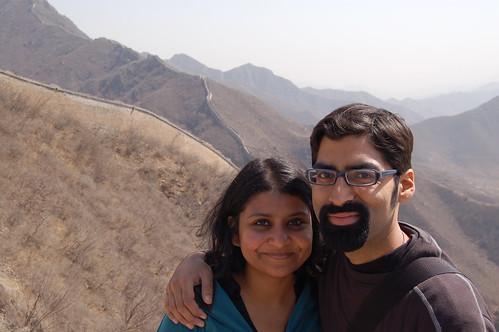
We're a landscape architect (Barnali) and tech geek (Anirvan) from San Francisco spending a year trying to live aviation-free, traveling across continents, and talking to people exploring solutions to transportation and the climate crisis.

Enter your email to stay updated!
(unsubscribe anytime)

Recent Comments

 
Close